
Most companies in India still treat their employee benefits programme as a series of projects. Health insurance is a project. The flexi-pay structure is a project. The hybrid-work allowance is a project. Each one gets stood up, runs for a few years, and either gets re-tendered or quietly dies when the budget tightens.
That model worked when benefits were thin and stable. It is starting to creak in 2026, for the same reason that company IT moved from "buy a server when a server is needed" to "operate a platform." Benefits have crossed the threshold where the right way to deliver them is to treat them as ongoing infrastructure rather than as discrete projects.
This is a short note from the operational side. It is the perspective we hear most often from HR ops leads at mid-size and large Indian employers, and the perspective that drives a lot of how we have built SmartLease at InnovRent.
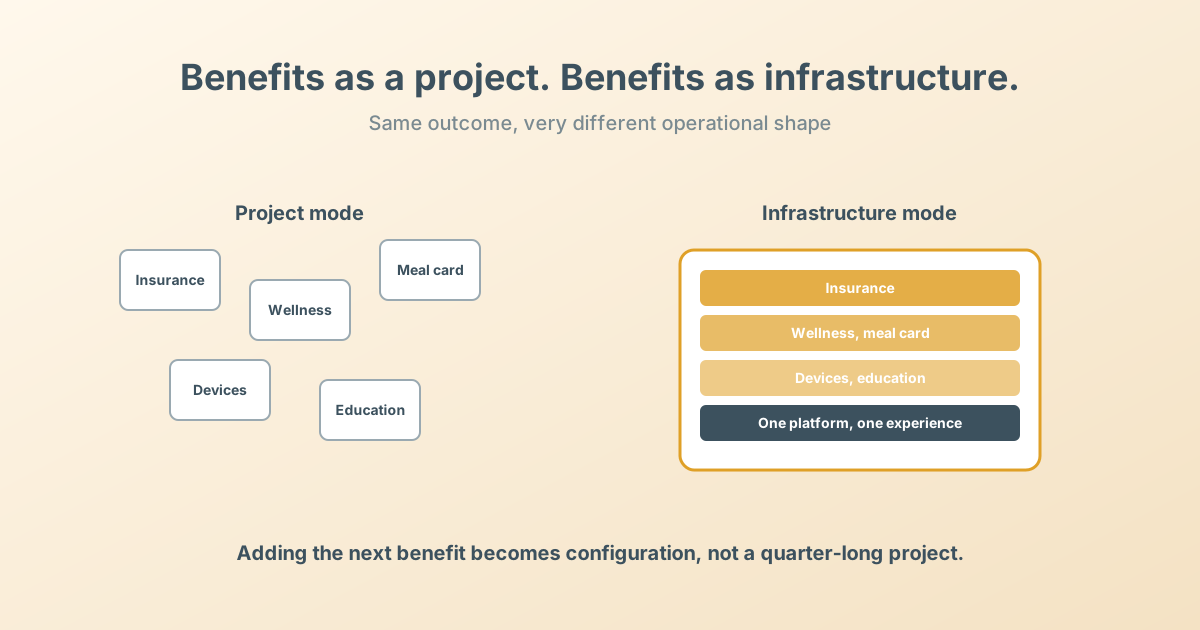
What a "project-mode" benefits programme looks like
In project mode, each benefit is a vendor selection, a contract, a rollout, and a renewal cycle.
Onboarding a new benefit takes a quarter or more. Communicating it to employees takes another quarter. Measuring whether it worked takes a year. By the time the data comes in, the budget cycle has moved on and the next benefit is being scoped.
What suffers is the connective tissue. The health vendor and the wellness vendor and the device benefit and the meal card all live in different systems. The employee has to remember which login is for which thing. HR has to consolidate reports from five places. Finance has to budget against five line items that may or may not move together.
It is not catastrophic. Companies have run this way for decades. But it scales linearly: every new benefit roughly doubles the operational load.
What "infrastructure mode" looks like
Infrastructure mode is the recognition that benefits are a continuous service, not a series of events.
In this model, the company picks an underlying platform and standard. New benefits are added by configuring inside the platform, not by setting up a separate vendor relationship. Employees see a unified experience: one login, one place to make choices, one place to find their entitlements.
The reporting is unified. The administration is unified. The audit trail is unified. The total ops cost grows sub-linearly with the number of benefits because the connective tissue is shared.
This is roughly what happened in finance with the move from one-off spreadsheets to an ERP, and in engineering with the move from custom scripts to platform-as-a-service. The benefits world is on a similar curve, about a decade behind.
What changes when benefits become infrastructure
Three things change in practice.
First, the cycle time of adding a new benefit drops from a quarter to a week. The expensive parts - employee onboarding, payroll integration, compliance documentation - are done once for the platform, not once per benefit. Adding a new device category, a new wellness vendor, or a new allowance becomes a configuration change rather than a project.
Second, the data improves. Because employees interact with one system, the data about benefit usage actually exists in one place. HR teams that have moved to infrastructure mode can answer questions like "what percentage of employees in our Bengaluru office have used the device benefit in the last quarter" without commissioning a report. The answer is in the dashboard.
Third, the conversation with employees becomes simpler. The employee does not need to know which vendor delivers which benefit. They just need to know what their company offers, and the platform handles the rest. That sounds like a small thing; it is not. Employees who can navigate their benefits in five minutes use them. Employees who can not, do not.
Where device leasing fits this picture
Structured device leasing has been one of the cleanest test cases for this shift, for a couple of reasons.
It involves real money and real assets, so it has to be administered carefully. Sloppy procurement, slow replacements, or messy end-of-term experiences turn the benefit into a complaint magnet.
It touches several parts of the company: HR, IT, finance, and the employee personally. That is exactly the kind of cross-functional benefit that infrastructure mode handles better than project mode.
And it scales with the company: a 50-person startup needs a device benefit that handles 50 devices; a 5000-person enterprise needs one that handles 5000. The two ends of that range are not the same product, but they are the same shape of product. A platform designed for both has to think infrastructure from day one.
What HR teams should look for
If your company is thinking about expanding its benefits in 2026, the practical advice is to evaluate vendors and platforms on their infrastructure characteristics, not just their feature lists.
Does the platform integrate cleanly with payroll? If yes, the friction of new benefits drops by an order of magnitude.
Does the data live in one place? If yes, the next budget cycle becomes a data-driven conversation rather than a guess.
Does the employee experience hold together? If yes, usage will be high and complaints will be low.
Can the platform handle benefits you have not added yet? If yes, you are buying infrastructure. If no, you are buying a project.
We have built SmartLease at InnovRent on the assumption that the answer to all four should be yes by default, not by exception. The companies that get the most out of structured benefits in 2026 are the ones that treat the underlying delivery as a long-term capability, not a series of short-term projects.
Where to read next
- How device leasing is changing employee benefits in India
- The Indian employee benefits landscape in 2026
- Hybrid work and the Indian device gap in 2026
If you are scoping how a benefits-as-infrastructure approach could work in your company, hello@innovrent.com is the right way to reach the team.
Sources
- EY India, Future of Pay 2026. https://www.ey.com/en_in/newsroom/2026/02/india-inc-projects-9-point-1-percent-salary-increase-in-2026-as-compensation-becomes-sharper-more-skills-led-ey-future-of-pay-2026-report
- EY India, The future of pay: Holistic rewards redefining talent strategies. https://www.ey.com/en_in/insights/workforce/the-future-of-pay-holistic-rewards-redefining-talent-strategies
- Nasscom, Return to Workplace Survey - Evolving Towards Hybrid Operating Model. https://nasscom.in/knowledge-center/publications/nasscom-return-workplace-survey-evolving-towards-hybrid-operating