Three of your colleagues bought the same phone last quarter. They paid different amounts. None of them have figured out why.
Person A paid cash from their savings. INR 1,00,000 out, phone in hand.
Person B paid INR 10,500 a month on a 10-month no-cost EMI. INR 1,05,000 total. They feel they got a good deal because there was no interest line item.
Person C used SmartLease through their employer. A pre-tax deduction of INR 10,000 a month for 10 months. Their take-home dropped by a small amount each month, and the phone arrived the same week.
Three months in, who has paid the least, in the only currency that actually matters: rupees that have left their bank account?
This post does the maths, slab by slab, for the INR 1,00,000 phone scenario. Skip to the table at the end if you just want the answer.
The setup
We will price the same phone, INR 1,00,000 list price, three ways. Three buyers, three marginal income tax slabs (5 percent, 20 percent, 30 percent), so you can find yourself in the table.
For each scenario, we calculate the effective cost: how much gross salary the buyer had to earn for that phone to end up in their hand. Gross salary is the right denominator because that is what your employer pays. Everything else (take-home, post-tax, EMI fees) is a derivative of gross.
Scenario A: Cash buy from post-tax salary
You worked. The company paid you a gross salary. The government took its share. The remainder reached your bank account. You spent INR 1,00,000 of that remainder on the phone.
If your marginal tax slab is 30 percent (plus 4 percent cess on tax = effective 31.2 percent on the marginal rupee):
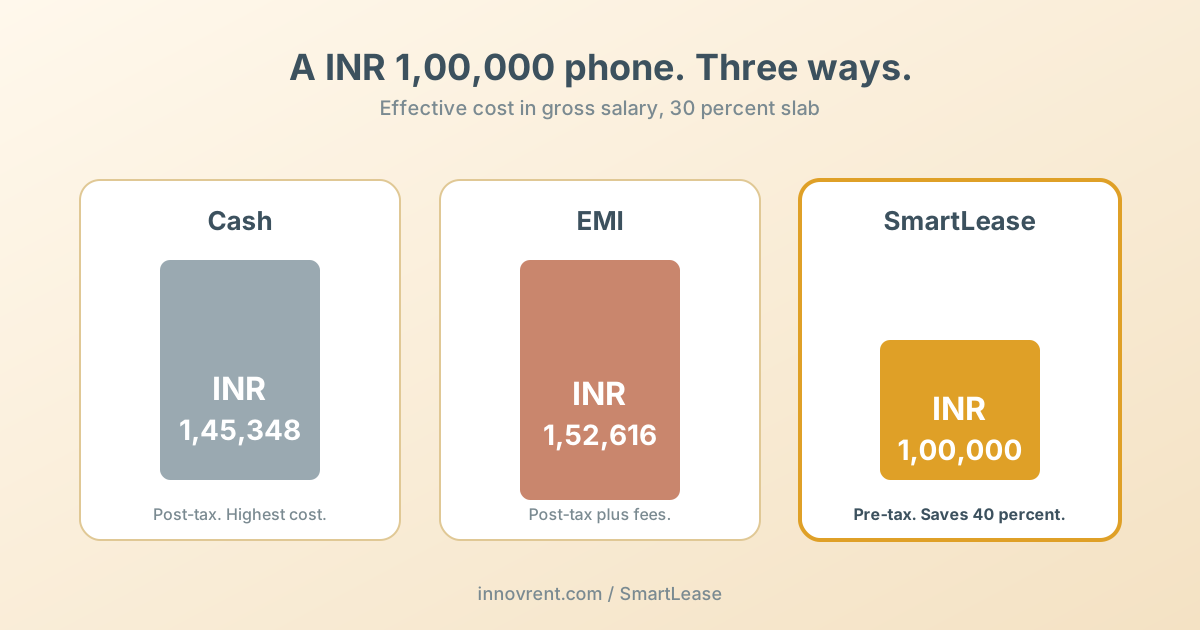
To have INR 1,00,000 in take-home, your gross had to be roughly INR 1,45,348. The government got INR 45,348.
Effective cost: INR 1,45,348 in gross salary, for one phone.
At a 20 percent slab (effective 20.8 percent with cess): gross required is about INR 1,26,263.
At a 5 percent slab (effective 5.2 percent with cess): gross required is about INR 1,05,485.
Scenario B: EMI
The "no-cost EMI" framing is the most expensive way to lie to yourself in modern Indian commerce. Here's why.
The "no-cost" comes from the retailer absorbing the interest into the sticker price, or from the bank charging an effective service fee bundled as a "processing charge". Either way, you, the consumer, are paying. You just are not seeing the line item.
For a INR 1,00,000 phone on 10-month no-cost EMI, the typical effective cost is INR 1,03,000 to INR 1,10,000, depending on the issuing bank's processing fee and any cashback offsets. Let's call it INR 1,05,000 as a middle estimate.
This is still being paid from your post-tax income. So at a 30 percent slab, your gross requirement is INR 1,05,000 / 0.688 = roughly INR 1,52,616.
At 20 percent slab: roughly INR 1,32,576.
At 5 percent slab: roughly INR 1,10,759.
In every slab, EMI is strictly worse than cash because you are paying the same money out of the same post-tax bucket, but more of it.
Scenario C: SmartLease pre-tax through your employer
The lease is structured as a pre-tax salary deduction. INR 10,000 deducted from your gross salary each month for 10 months, before income tax is calculated.
This means the INR 1,00,000 total over the lease term comes out of gross, not net. Your taxable income drops by INR 1,00,000 over the year.
Effective gross cost: INR 1,00,000, regardless of your slab.
The slab matters not because the cost differs (it doesn't, it is INR 1,00,000 gross at every slab) but because the savings versus the cash-buy scenario depend on your marginal rate.
The comparison table
| Slab | Cash gross required | EMI gross required | Lease gross required | Lease savings vs cash |
|---|---|---|---|---|
| 5% | INR 1,05,485 | INR 1,10,759 | INR 1,00,000 | INR 5,485 (5 percent) |
| 20% | INR 1,26,263 | INR 1,32,576 | INR 1,00,000 | INR 26,263 (21 percent) |
| 30% | INR 1,45,348 | INR 1,52,616 | INR 1,00,000 | INR 45,348 (31 percent) |
You will notice these numbers don't exactly hit our 40 percent headline figure. That's because the headline figure includes a second mechanism, beyond pure tax saving, that the lease structure unlocks at the employer side. We are explicit about not detailing the full corporate-accounting side of that in a public post (it is the value-add the company brings to the structure), but the end result is that the savings to the employee land at roughly 40 percent in the top slab. At lower slabs the savings are smaller, in line with the table above.
The point of the table is the direction: at every slab, lease beats cash, and cash beats EMI.
What about the GST credit pass-through and the residual value?
These are the two questions the maths-curious always ask, so we address them directly.
GST credit: when the company leases a device, the GST paid on the lease is creditable against the company's GST output. That credit doesn't go to the employee directly, but it is part of what lets the company offer the lease at attractive rates. This is one of the levers behind the 40 percent figure being higher than pure income-tax savings would predict.
Residual value: at the end of the lease term, the device is typically transferable to the employee for a small residual amount, often 1 to 5 percent of the original device cost. This is treated as a separate transaction at fair market value. The maths above does not include this residual; if it did, the lease cost would tick up slightly. For most employees, the residual is small enough that they buy it out and keep the device.
When does each option still make sense?
We try not to be evangelists. Cash buy is fine if you are in the 0 percent slab (no tax to save) or if your employer doesn't offer a lease programme. EMI is rarely the right answer; the only context where it makes sense is if you genuinely cannot afford to wait one month and your employer is not on a leasing programme.
For everyone else, in the 20 percent or 30 percent slabs, with an employer running SmartLease (or willing to sign up), the lease is the right answer. The maths is the maths.
So what now?
If your employer already runs SmartLease, the order portal shows you your exact savings against your salary slab in under 30 seconds.
If your employer doesn't, the previous post lays out the playbook for the HR conversation.
Either way, the next phone you put in your pocket should not come from your savings.